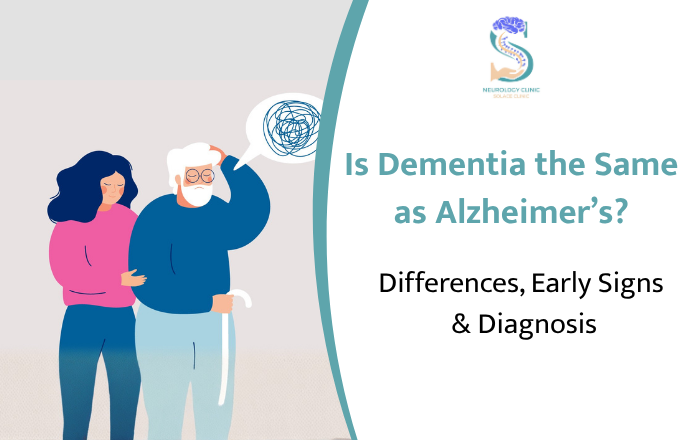
Is Dementia the Same as Alzheimer’s? Differences, Early Signs & Diagnosis
Recent Posts
If you’ve ever used the words “dementia” and “Alzheimer’s” interchangeably, you’re not alone. Most people do. But here’s the truth — dementia and Alzheimer’s are not the same thing, and understanding the difference could be one of the most important things you do for yourself or someone you love.
Maybe you’ve noticed a parent repeating the same question twice in one conversation. Or perhaps your spouse has been forgetting familiar names more often lately. That quiet worry in the back of your mind — is this normal, or is something wrong? — deserves a real answer.
In India, over 5.3 million people are currently living with dementia, and that number is expected to double by 2050. Yet many families wait years before getting a diagnosis, simply because they didn’t know where to start. This blog will change that.
What Is Dementia?
Dementia is not a single disease. It is an umbrella term — a way of describing a group of symptoms that affect memory, thinking, behaviour, and the ability to handle everyday tasks.
Think of it like “fever.” Fever isn’t a disease on its own; it’s a sign that something else is happening inside the body. Dementia works the same way. It tells you something is wrong with the brain, but not necessarily what is causing it.
For a doctor to diagnose dementia, a person typically needs to show:
- Memory loss that disrupts daily life
- Difficulty thinking clearly or solving simple problems
- Confusion about time, place, or people
- Changes in mood or personality
Importantly — dementia is not a normal part of ageing. Forgetting where you left your keys once in a while is normal. Forgetting what keys are for is not.
What Is Alzheimer’s Disease?
Alzheimer’s disease is the most common cause of dementia. It accounts for roughly 60–80% of all dementia cases worldwide. It is a specific brain disease where abnormal proteins called amyloid plaques and tau tangles — build up in the brain and slowly destroy brain cells over time.
The simplest way to remember the difference:
All Alzheimer’s is dementia — but not all dementia is Alzheimer’s.
Alzheimer’s always leads to dementia symptoms. But dementia can also be caused by many other conditions, including vascular dementia (caused by reduced blood flow to the brain, often after a stroke), Lewy body dementia, frontotemporal dementia, or even reversible conditions like vitamin B12 deficiency and thyroid problems.
That last point is worth emphasising some forms of dementia are reversible if caught early enough. This is one of the strongest reasons to see a neurologist as soon as symptoms appear, rather than waiting.
Dementia vs Alzheimer’s: Key Differences at a Glance
Dementia Alzheimer’s Disease
What it is A group of symptoms A specific brain disease
Caused by Many possible conditions Abnormal protein build-up
Reversible? Sometimes No
First signs Varies by type Usually memory loss
Treatment Depends on the cause Medications can slow progression
7 Early Warning Signs You Should Not Ignore
Both dementia and Alzheimer’s tend to develop slowly. Symptoms are easy to dismiss in the beginning. Here are the signs that genuinely warrant attention:
1. Memory loss that keeps happening — Forgetting recent conversations, appointments, or names — and not recalling them even later — is one of the earliest signs of Alzheimer’s disease.
2. Difficulty with familiar tasks — Struggling to cook a recipe they’ve made for years, or losing track of monthly bills that were once managed easily.
3. Confusion about time or place — Regularly losing track of dates, seasons, or forgetting where they are and how they got there.
4. Trouble finding words — Stopping mid-sentence without knowing how to continue. Repeating the same story without realising it.
5. Poor judgement — Making unusual financial decisions, or not recognising when they need medical help.
6. Withdrawing from people and activities — Pulling away from family, friends, or hobbies not by choice, but because they’ve become confusing or overwhelming.
7. Mood and personality changes — Becoming unusually suspicious, anxious, or irritable — especially in unfamiliar situations.
If you’re noticing several of these signs together, or a clear change from how this person used to be, it’s time to speak with a neurologist.
How Is Dementia Diagnosed?
There is no single test for dementia or Alzheimer’s disease. A proper diagnosis involves several steps:
- Clinical history — A neurologist will ask detailed questions about when symptoms started and how they’ve changed over time.
- Cognitive tests — Standardised assessments like the MMSE or MoCA test memory, attention, language, and reasoning.
- Blood tests — These help rule out reversible causes like thyroid issues, vitamin deficiencies, or infections.
- Brain imaging — MRI or CT scans can show structural changes in the brain. PET scans can detect amyloid plaques associated with Alzheimer’s disease.
Early diagnosis genuinely matters. When dementia or Alzheimer’s is identified early, there is more time to explore treatment options, make important decisions, and in some cases, treat a reversible cause entirely.
FAQ
Q1: Can a young person get Alzheimer’s or dementia?
Yes. Early-onset Alzheimer’s disease can affect people in their 40s and 50s. If you notice symptoms in a younger person, don’t dismiss them.
Q2: Is all memory loss a sign of dementia?
No. Occasional forgetfulness is normal. Dementia-related memory loss is progressive, worsens over time, and affects daily life.
Q3: Can dementia be reversed?
Some causes of cognitive decline — like vitamin deficiencies or thyroid problems — are reversible. Alzheimer’s disease itself cannot be reversed, but its progression can be slowed with the right treatment.
Q4: When should I see a neurologist?
If you notice three or more of the early warning signs listed above, or a clear change in memory or behaviour over several months, see a neurologist promptly. Don’t wait for symptoms to become severe.
Consult Dr. Sumit B. Kharat — Neurologist in Wanwadi, Pune
If you’re worried about memory changes in yourself or a loved one, speaking with the right doctor makes all the difference.
Dr. Sumit Kharat is a trusted Neurologist in Wanwadi, we serve patients from Salunkhe Vihar, NIBM, Undri, Lullanagar, Kondhwa, and BT Kawade Road, specializing in diagnosing and treating neurological conditions at Solace Neuro Clinic. From dementia and Alzheimer’s disease to stroke, epilepsy, and memory disorders, Dr. Kharat is committed to giving every patient clear answers and the right care.
Your brain health matters. Don’t put it off.
📍 Solace Neuro Clinic, Wanwadi, Pune
📞 Book your consultation today.