Sudden Double Vision: Causes, Warning Signs & When to See a Neurologist
Recent Posts
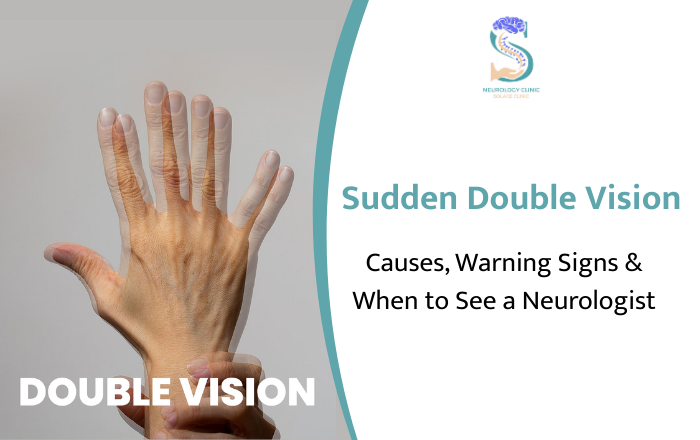
Have you ever looked up from your phone and suddenly seen two of everything? That disorienting moment where one image splits into two — it’s scary, confusing, and hard to shake off. If you’ve experienced sudden double vision, you’re not alone — and more importantly, you should not ignore it.
Sudden double vision (medically known as diplopia) is not just an eye problem. It can be your body’s way of signalling something serious happening in your brain or nervous system. This article breaks down everything you need to know — in plain, simple language.
What Is Sudden Double Vision?
Double vision means seeing two images of a single object at the same time. They may appear side by side, stacked, or at an angle. This is different from blurry vision.
There are two types:
- Monocular diplopia — happens in one eye, even when the other is closed. Usually an eye-level problem.
- Binocular diplopia — happens when both eyes are open and disappears when you close one eye. This type is more concerning and is often linked to neurological causes.
7 Common Causes of Sudden Double Vision
1. Stroke or Mini-Stroke (TIA)
This is the most urgent cause. A sudden double vision that appears within seconds — especially with facial drooping, arm weakness, or speech difficulty — can signal a stroke. Around 800,000 strokes occur every year in the US alone, and vision changes are among the earliest signs.
2. Brain Aneurysm
A bulging blood vessel pressing on a nerve near the eye can cause sudden double vision, often with a severe headache and a drooping eyelid. This is a medical emergency.
3. Cranial Nerve Palsy
The nerves controlling eye movement (3rd, 4th, and 6th cranial nerves) can be damaged by diabetes, high blood pressure, or trauma — causing one eye to drift and producing double vision.
4. Multiple Sclerosis (MS)
MS attacks the protective covering of nerve fibres. Up to 33% of MS patients experience double vision at some point, often as one of the first symptoms.
5. Myasthenia Gravis
This autoimmune condition weakens muscles — the eye muscles are usually hit first. Double vision that worsens with fatigue and gets better after rest is a classic sign.
6. Head Injury or Concussion
Even a mild knock to the head can disrupt the brain’s eye-movement system, leading to double vision after head trauma.
7. Thyroid Eye Disease
An overactive thyroid can cause eye muscles to swell, pulling the eyes out of alignment and causing diplopia — often worse in certain directions of gaze.
5 Warning Signs That Make Double Vision an Emergency
Some symptoms alongside sudden double vision mean you need to go to the emergency room immediately:
- 🚨 Sudden onset with no clear reason
- 🚨 Severe headache — the worst of your life
- 🚨 Facial drooping, arm weakness, or slurred speech
- 🚨 Drooping of one eyelid
- 🚨 Double vision that appeared after a head injury
Use the FAST rule — Face drooping, Arm weakness, Speech problems, Time to call for help.
When Should You See a Neurologist for Double Vision?
See a neurologist if your double vision:
- Came on suddenly with no obvious trigger
- Has happened more than once
- Lasts longer than a few minutes
- Comes with headache, dizziness, or weakness
- Is getting worse over time
Temporary double vision from tiredness may seem harmless — but repeated episodes are never normal. A neurologist can find the root cause and stop it from becoming something bigger.
How Is Sudden Double Vision Diagnosed?
A neurologist will look at the full picture — not just your eyes. Diagnosis typically involves:
- Eye movement exam — checking how each eye moves in all directions
- MRI or CT brain scan — to rule out stroke, MS, tumours, or nerve compression
- Blood tests — for thyroid function, blood sugar, and autoimmune markers
- Specialised tests — such as the Tensilon test if myasthenia gravis is suspected
Treatment Depends on the Cause
The right treatment for diplopia depends entirely on what is causing it:
- Stroke → Emergency treatment to restore blood flow
- MS → Steroids for flare-ups; long-term medication to slow progression
- Myasthenia Gravis → Medication to improve nerve-muscle signalling
- Diabetic nerve palsy → Blood sugar control; often resolves in 2–3 months
- Thyroid eye disease → Treating the thyroid; surgery in severe cases
- Prism glasses → Used in many cases to help reduce double images while the cause is being treated
Early diagnosis leads to faster recovery. The longer you wait, the harder some conditions become to treat.
FAQ: Quick Answers on Double Vision
Q: Can stress cause double vision?
Stress can cause eye strain — but true double vision (two separate images) is not a stress symptom. Get it checked.
Q: Will double vision go away on its own?
Some cases do resolve — but only after a proper diagnosis. Never wait without seeing a doctor first.
Q: Is double vision more common after 50?
Yes. In adults over 50, sudden double vision is often linked to diabetes, high blood pressure, or stroke risk. Always see a neurologist promptly.
Q: Can children get sudden double vision?
Yes. and it’s always urgent in children. It can indicate a brain tumour or viral nerve condition.
See a Neurologist in Wanwadi, Pune — Dr. Sumit Kharat at Solace Neuro Clinic
If you or someone you love is dealing with sudden double vision, diplopia, or any unexplained vision change — do not put it off.
Dr. Sumit Kharat, Neurologist at Solace Neuro Clinic, Wanwadi, Pune, evaluates and treats conditions causing double vision — from stroke and MS to nerve palsies and myasthenia gravis. With a patient-first approach and thorough diagnostic care, Dr. Kharat helps you get clear answers and the right treatment — without the wait and worry.
📍 Solace Neuro Clinic, Wanwadi, Pune
👨⚕️ Dr. Sumit Kharat — Neurologist
📅 Book your consultation today. Your vision and brain health cannot wait.